
Playing It Out
The second week arrived with a plan.
After the ribber refused to cooperate in week one I had spent the days in between turning the problem over quietly. No resolution, just possibilities. I reached out to the machine knitting community to see if anyone had encountered something similar and came back mostly empty handed. So I mapped out a few troubleshooting approaches in my head and walked back into the space ready to try them.
The original concept still did not work. But somewhere in the process of working through what would not happen, I found something that would. An hour and four minutes later, a sample came off the machine.
I sat with that number for a moment. One hour and four minutes for a swatch. A small rectangle of knitted fabric. If that technique were to be translated into a full garment, the time required would make the price point almost impossible to justify to a customer, and almost impossible to sustain as a maker. This is exactly where the domestic machine meets its honest limit, and where industrial machinery steps in. Not because the domestic machine is incapable, but because time is real and finite and it does not bend to creativity alone. The sample on the wall has its time written beside it. That is the point.
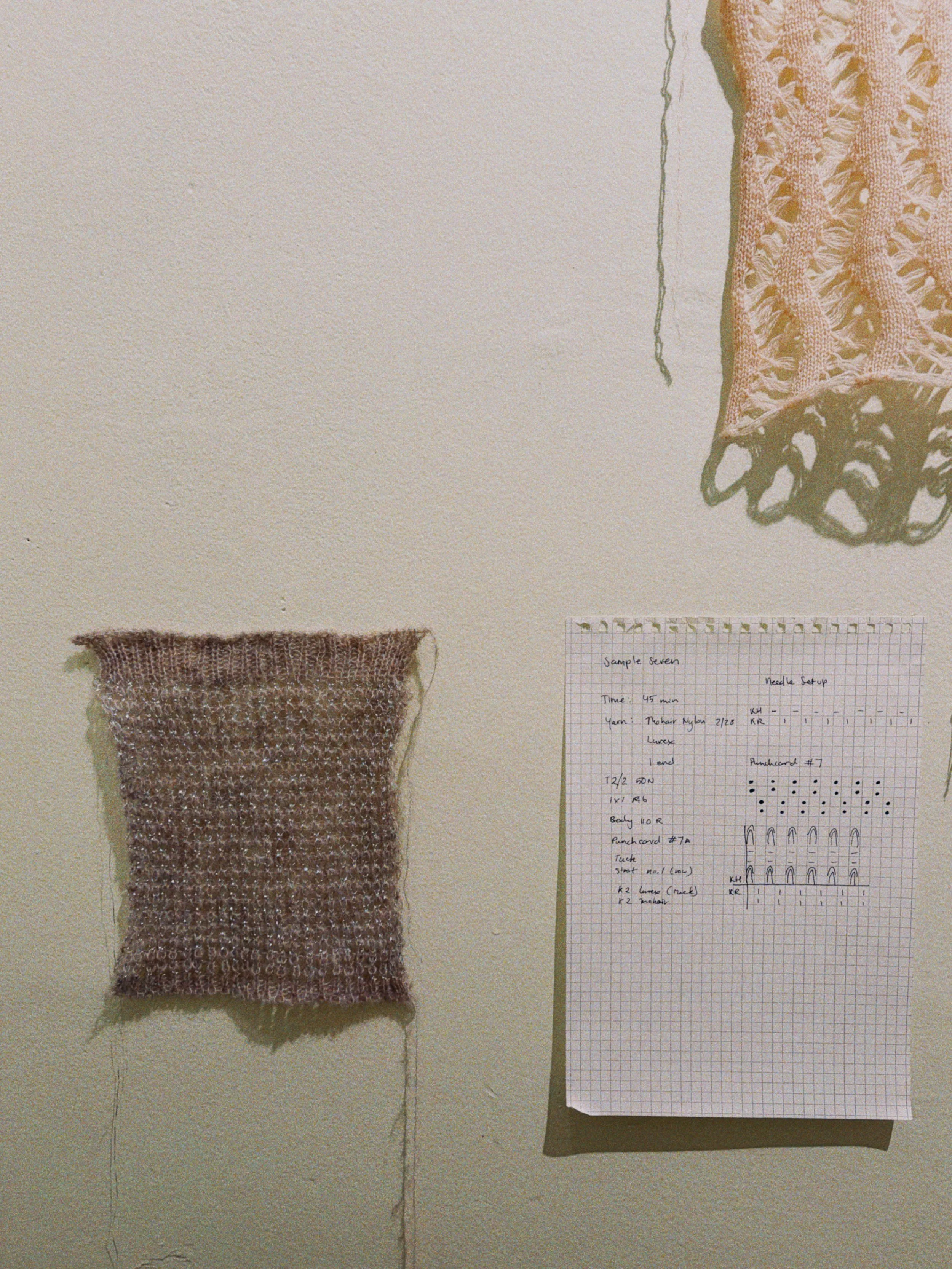
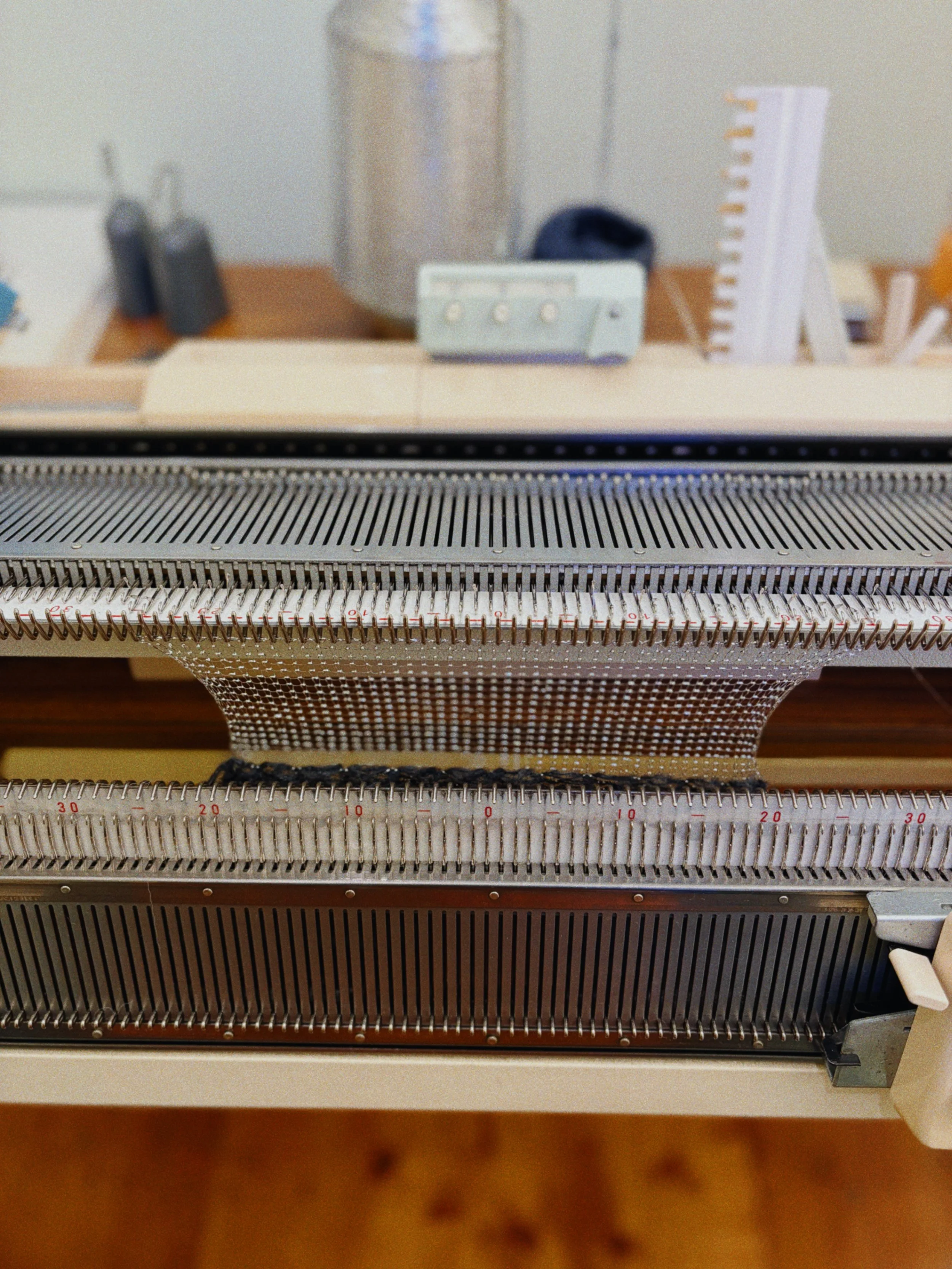
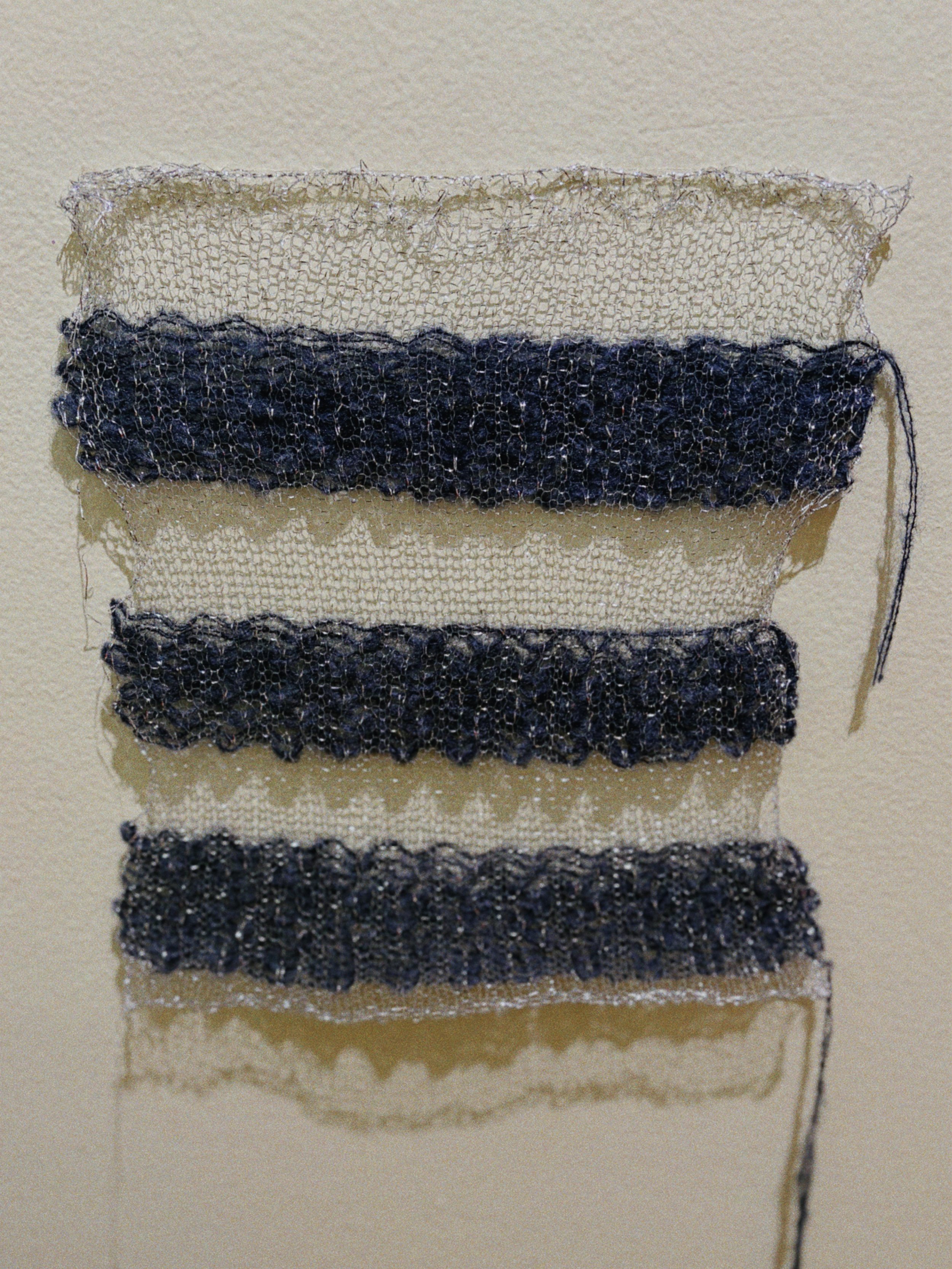
The rest of the week belonged to punchcards and a combination I have been quietly curious about for some time. Lurex and mohair knitted together, run through the punchcard mechanism to create textural variation across the surface of the fabric.
The results were prettier than I expected and more fragile than I would like. Lurex as a single end is not strong. The whole time I was knitting I was waiting for it to snap mid row, holding my breath slightly with each pass of the carriage. It held. But the reality is that without a stronger fibre to anchor it, lurex in a garment would not last the way Loré Loré work is designed to last. The samples are delicate and whimsical and genuinely beautiful. They are also honest about their own limitations, which feels appropriate for this project.
I have always underused the standard punchcards that come with the machine. The manuals present them as tools for repetitive pattern work and I have largely followed that framing without questioning it. This week I started to question it. What happens when you manipulate the yarn, shift the tension, layer techniques on top of the card's basic function? The manual does not cover that territory. That territory is where the interesting work lives.
I am beginning to find my way into it. Still hesitant at the edges, but more willing than I was in week one to step away from what I know and toward what I do not yet. The samples on the wall this week feel less like documentation and more like the beginning of something. I am not sure what yet. That feels right.