Thirteen Minutes
The first day was not what I expected.
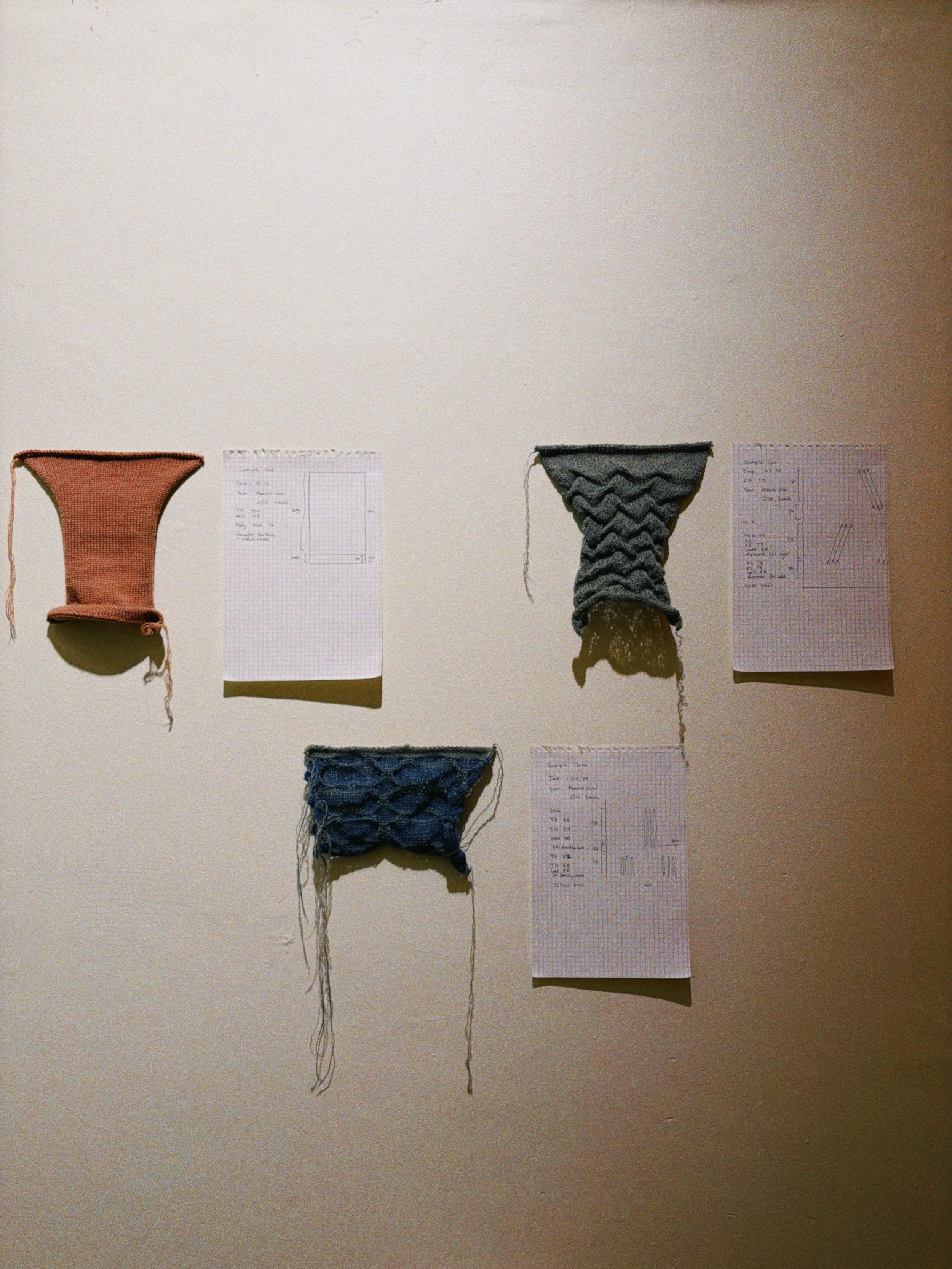
I had set up, the machine was ready, and I sat down to begin with what should have been the simplest possible starting point. Stockinette. The most fundamental stitch in machine knitting. Plain, even, reliable. I chose it deliberately, as a baseline to compare against the more complex samples to come. It took thirteen minutes. Neat, professional, complete.
And then I sat with that for a moment.
What I had not anticipated was how difficult it would be to knit without a product in mind. No brief, no customer, no end use to design toward. Just the machine, the yarn, and the question of what to make next. I have spent years in production mode, every decision filtered through viability and time efficiency. Switching that off and simply being present in the making was harder than any technical challenge I had planned for. It is something I am still working through.
But the stockinette told me something useful before I moved on. Thirteen minutes for a clean, complete sample. The stitch itself is not where the time goes. Time lives in the construction. In the shaping, the transfers, the fully fashioned details that turn a knitted fabric into a garment. That is what this project is here to document.
The second and third samples introduced a technique I have not explored seriously since university, one that has been quietly trending amongst machine knitters and for good reason. Welting. At its simplest, welting is the act of picking up stitches from a previous row and bringing them up to meet a later row. That pinch of fabric, repeated across the knit, begins to manipulate the form. Direction shifts. Volume builds. The surface starts to move.
In the second sample I displaced the welts diagonally, working from right to left across the swatch. The result was a soft, angled movement not unlike ruching. Gentle, considered, quietly interesting.
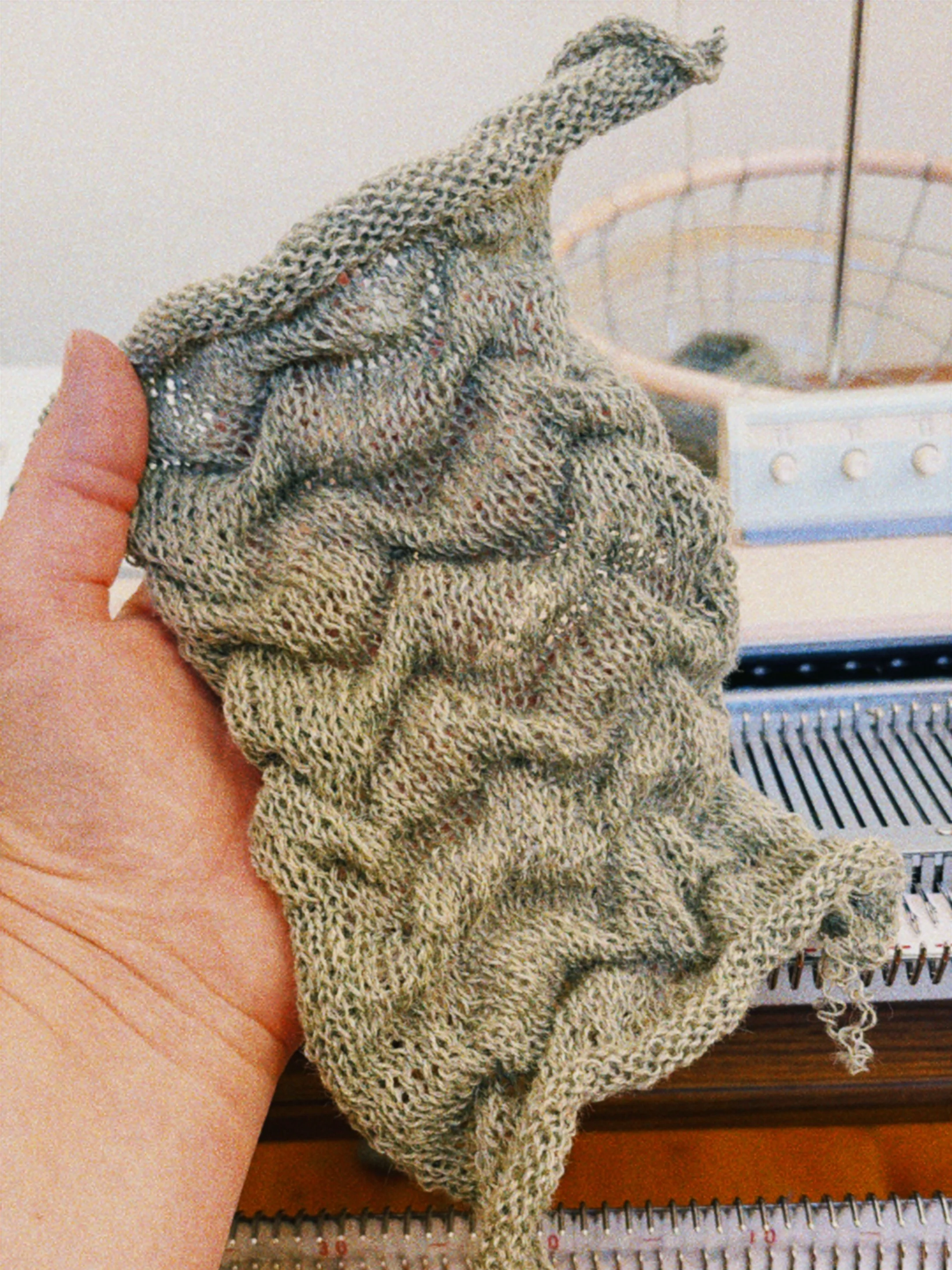
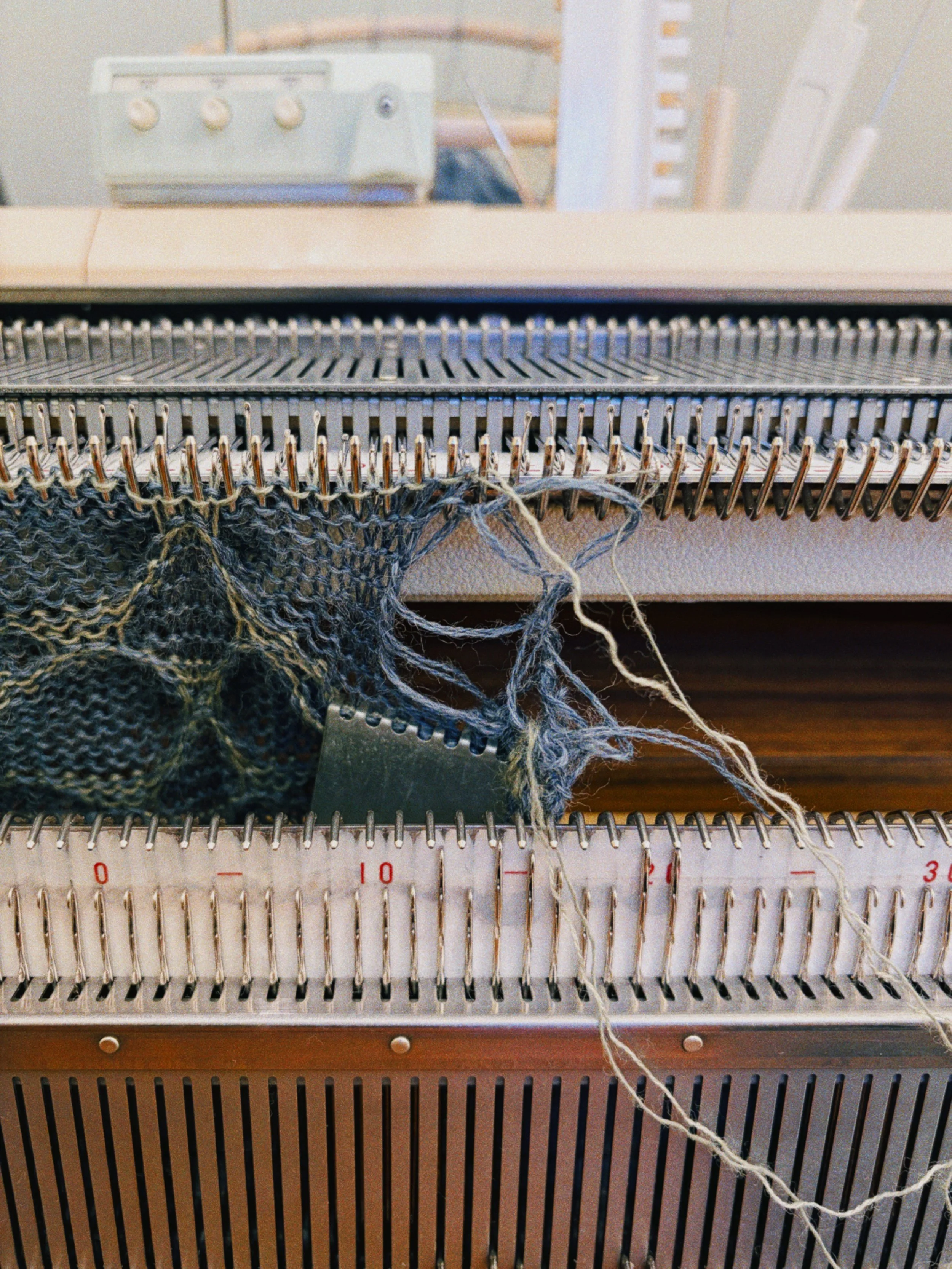
The third sample used the same technique but introduced striped colour and placed the welted stitches back within the same warp. The effect was a volumous honeycomb, textured and dimensional in a way that photographs do not quite capture. It is a piece you want to touch.
It was not without its moments. Twice the sample dropped on one side, stitches cascading down and requiring careful, patient recovery. Working them back up by hand, one at a time, while the rest of the knit waited. This is the part that rarely gets acknowledged. The machine knits quickly. The fixing does not. Dropped stitches, tension inconsistencies, the small disasters that happen mid-row — none of that time is ever counted in a price. Sometimes it is not even worth repairing and a piece gets restarted entirely. The swatch sits on the wall with its imperfections intact. That is the point.